The Hyundai Sonata is a mid-size car manufactured and marketed globally by Hyundai Motor Company. From the sixth generation onwards, it is known as the i45 in the Australian and New Zealand markets. The first Sonata was only for the Korean domestic market. The vehicle was unveiled in South Korea in November 1985. Engine choices include 1.8L or 2.0L I4 (The latter also finding its way into the 1987 and later Stellar, and in MPI form the 1986 Hyundai Grandeur.) The body was based on the Hyundai Stellar. The Y2 Sonata was part of Hyundai's expansion in North America after the success of the Excel. It was introduced in South Korea on June 1, 1988. It was then introduced in Canada in September 1987 as a 1988 model, and in 1988, as a 1989 model in the United States. The exterior was designed by Giorgetto Giugiaro of ItalDesign. The vehicle received a mid-term facelift in 1991. It replaced the Stellar as Hyundai's large family car. Sonatas were built in Ulsan, Korea, and in Bromont, Quebec. The Sonata was designed by Hyundai and featured Mitsubishi's engineering, including the platform from Galant Σ and its 2.4 L 110 hp (82 kW) Sirius I4 engine as used in American-market models. A 3.0 L V6 based on the Mitsubishi 6G72 arrived in 1990. The U.S. model received the 2.0 L engine for the 1992, replacing the original 2.4 L engine.
First Test: 2011 Hyundai Sonata

The Y3 Sonata debuted in 1994, as a 1995 model. The base engine in most markets was a 2.0 L 77 kW (105 PS; 103 hp) Sirius I4, but there was a 3.0 L, 107 kW (145 PS; 143 hp) Mitsubishi V6 option in some markets. This generation continued after the demise of the Bromont, Quebec plant in September 1993. After that, all Sonatas would be built in Korea, until the opening of the Beijing Hyundai plant in December 2002. The 1994 model of the Sonata was the first to be sold in the UK without having to be privately imported. It was available as an 4 door saloon only, with a v6 engine and also had as standard: ABS, air conditioning, an alarm, alloy wheels, body coloured bumpers, CD Multichanger, climate control, cruise control, driver's airbag, electric driver's seat, electric mirrors, electric sunroof, folding rear seats, front electric windows, front fog lights, a full size spare wheel, heated mirrors, isofix child seat anchor points, leather seat trim, lumbar support, PAS, passenger's airbag, rear electric windows, remote locking, Sat Nav, side airbags, and traction control. There was also an additional CDX model with a 2.0lt engine, which has most of the standard model's features, minus the CD Multichanger, climate control, cruise control, Sat Nav, traction control. A facelift for the Sonata (Y3 facelift) in 1996 saw modifications to the front and rear. The four-cylinder engine was also increased to 92 kW (125 PS; 123 hp) for that year as well. A new model arrived in 1998, launching the (EF) series. Engines were 2.0L 136 hp, 2.4 L 138 hp (103 kW) Hyundai Sirius and a 2.5 L 170 hp (127 kW) Hyundai Delta V6. A special 10-year warranty was available. Known serious problems include a failure of input and output speed sensors on automatic transmission models equipped with the V6. The Kia Optima (called the Magentis outside of the United States) was based on the same automobile platform of this generation of Sonata and shared the same doors and some other panels. This Sonata also shared a platform with the first-generation Hyundai Santa Fe, a compact crossover SUV.


The NF Sonata was launched in August 2004 in Korea, based on a new platform created from the project NF. The company's first all-aluminum I4 engine, dubbed Theta, debuted in the new Sonata. Engine choices at launch were a 2.4L I4 rated 164 bhp (122 kW) at 5800 rpm and a 3.3L V6 rated 237 bhp (177 kW) V6. The diesel version was used as a taxicab in Singapore. Diesel versions are available in Europe and New Zealand. The U.S. May 2005 launch of the new Sonata coincided with the production commencement at the company's first U.S. assembly plant, in Montgomery, Alabama. Classified by the U.S. Environmental Protection Agency as a large car, the fourth generation was 2 in (50.8 mm) longer and taller and 1 in (25.4 mm) wider than the previous generation. Standard features in U.S. models included anti-lock braking system/electronic stability control/traction control system as well as six airbags (driver/front passenger front and side, and side curtain). The redesigned vehicle was unveiled at the 2008 Chicago Auto Show as a 2009 model year vehicle. The production version was sold as the Hyundai Sonata Transform in Korea, and the model debuted elsewhere as an 'early' 2009 model. The styling was done primarily at HATCI (Hyundai-Kia America Technical Center, Inc) in Superior Township, Michigan. The redesign features revised engines, front fascia and chrome 3 bar grill, taillights (turn signals became red), jewel-projector headlights, new 10-spoke wheel cover designs for the Limited models (as opposed to sharing the 5-spoke design from the SE model),and an extensively revised IP (Instrument Panel). Hyundai adopted "slush molding,” a production technique that enables a much higher grade of texturing and shaping of the IP surface. The YF models were originally developed in 2005, with a development cost of ₩450 billion (US$ 372 million*). Sales of the vehicle in South Korea began on 2 September 2009, before the production vehicle's South Korean launch. In South Korea, The 6th Sonata delivers its 2-liter Theta II MPi gasoline engine (Max output 165 PS (121 kW; 163 hp), Max torque of 20.2㎏·m). Its fuel economy is more than 11% improved. For the US market, Hyundai uses their new direct injection 2.4 liter four cylinder engine. With direct injection technology this new engine will improve gas mileage over previous models and produces 201 PS (148 kW; 198 hp) at 6300 rpm and 25.5 kg·m (250 N·m; 184 lb·ft) at 4250 rpm. It is part of the Theta II engine lineup. Furthermore, all engines are offered with a new six-speed automatic transmission. The 6th Sonata is built on hot-stamped ultra high-strength steel.The 2011 Hyundai Sonata Hybrid sales began near the end of February 2011. The Sonata Hybrid drivetrain combines a 2.4-liter engine with six-speed automatic transmission, and a 30kW electric motor and lightweight lithium polymer batteries to produce a full gasoline-electric hybrid with 37 miles per US gallon (6.4 L/100 km; 44 mpg-imp) in the city and 39 miles per US gallon (6.0 L/100 km; 47 mpg-imp) on the highway. This powertrain will be share by the 2011 Kia Optima Hybrid.




 New 2011 Volvo C30 On Red Color
 Elegant Silver 2011 Volvo C30
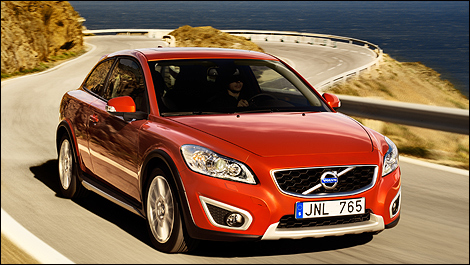 2011 Volvo C30 On The Road
 Luxury 2011 Volvo C30
 2011 Volvo C30 Steering Wheels and With High Technology
 White 2011 Volvo C30
 2011 Volvo C30 Luxury Interior
 Sporty 2011 Volvo C30 For Racing
 2011 Volvo C30 Hatchback